


3, Dec 2025
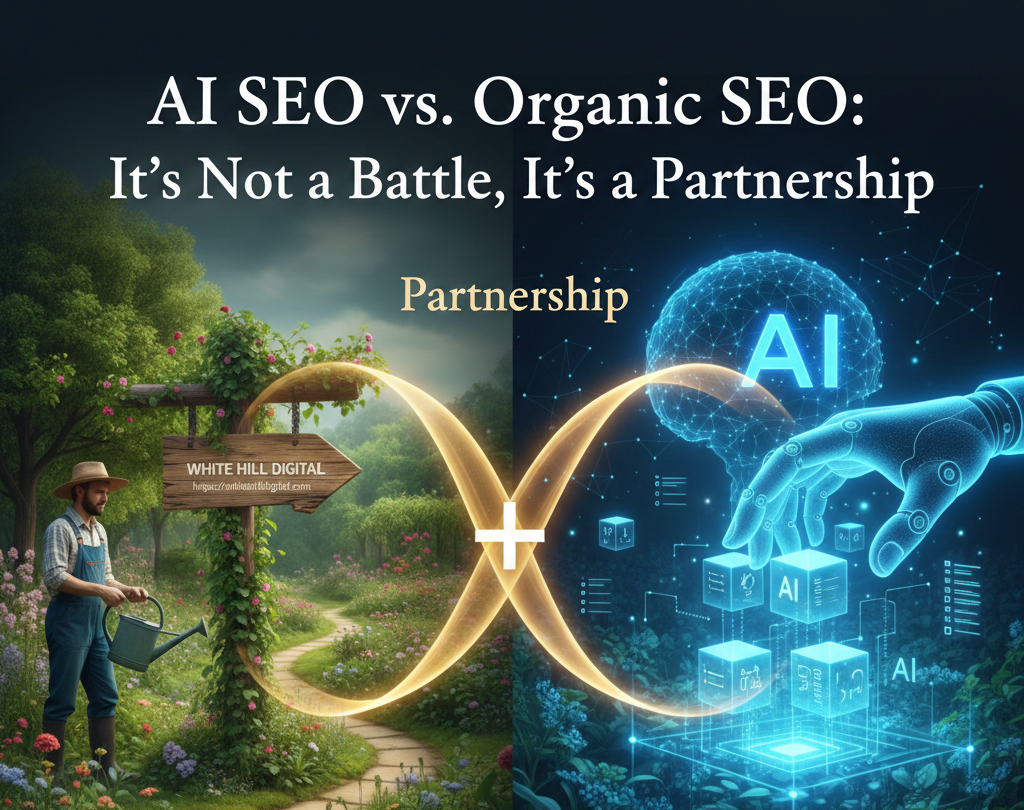
AI SEO vs. Organic SEO: It’s Not a Battle, It’s a Partnership
The ground beneath the SEO landscape is shifting—and the tremors are being caused by Artificial Intelligence. With the rise of AI-powered search results like Google’s AI Overviews and the increasing use of Large Language Models (LLMs) like ChatGPT, the old rulebook of Search Engine Optimization is getting a radical update.
So, is traditional Organic SEO dead? Is AI SEO the only way forward? The short answer: No, and no.
The reality is that successful visibility in the modern search ecosystem requires a strategic marriage between the two. Let’s break down the differences and discover why a hybrid approach is your winning ticket.
For businesses looking to secure their ranking foundation while adapting to the AI era, partners like White Hill Digital are focusing on this exact synergy.
What’s the Core Difference?
Think of it simply:
- Traditional Organic SEO helps humans find your content through ranked links on a Search Engine Results Page (SERP).
- AI SEO (or Generative Engine Optimization) helps AI understand and use your content to generate a direct, synthesized answer.
While they share the ultimate goal—visibility and authority—their focus and methods are fundamentally different.
| Feature | Traditional Organic SEO | AI SEO / GEO |
| Primary Goal | Achieve a high rank (a “blue link”) on Google/Bing SERPs. | Be cited, mentioned, or summarized in AI-generated answers. |
| Optimization Focus | Keywords, backlinks, on-page factors (titles, meta-data). | Clarity, structure, context, and topical authority. |
| Ranking Factors | Domain authority, link profile, keyword density, technical SEO. | Entity authority (trust), E-E-A-T, factual consistency, modular content. |
| User Experience | Leads to a click to your website. | Delivers a direct answer (often a “zero-click” search). |
| Content Strategy | Optimize a page for a primary keyword and related secondary keywords. | Optimize specific, modular sections to answer distinct, conversational questions. |
🔎 Traditional Organic SEO: The Unshakeable Foundation
Traditional SEO isn’t obsolete; it’s the stable foundation upon which AI SEO is built. These principles are what establish your site’s authority and trust with all search engines—including the AI-powered ones.
- Keywords and Intent: You still need to research what people are searching for and align your content with user intent (informational, navigational, transactional).
- Technical SEO: Site speed, mobile-friendliness, crawlability, and schema markup are more critical than ever. A slow, broken site will not be used by an AI model.
- Backlinks & Authority: Earning high-quality backlinks from reputable sites remains a core signal of trust and authority—two factors AI systems prioritize when selecting sources for their answers.
The takeaway: If your website has a weak organic foundation, no amount of AI-generated content will save it.
🧠 AI SEO: Optimizing for Understanding
AI SEO is about making your content so clear, structured, and authoritative that a machine can easily extract, trust, and cite your information.
Here’s how the focus shifts:
- Structure is King: AI loves structure. Use clear, descriptive headings (H2, H3), bulleted lists, numbered steps, and comparison tables. This makes your content “modular,” allowing the AI to grab a concise answer without needing the surrounding context.
- Front-Load the Answers: Unlike a traditional essay, don’t bury your key insights. Place the direct answer to the heading’s question in the very first sentence of the section.Bad Example: “Another thing to note is that keyword clusters…”Good Example: “Keyword clustering improves topical depth because it helps search engines understand the full context of a subject.”
- Topical Authority: Instead of just optimizing for a single keyword, you must cover an entire topic cluster with semantic completeness. AI models look for deep, factually consistent expertise, not just keyword stuffing.
- Embrace Zero-Click: The goal of AI search is to answer the user’s question directly. Your aim is to ensure your brand is the source it quotes. Even without a click, a citation in an AI Overview builds brand visibility and authority.
🤝 The Winning Strategy: A Hybrid Approach
The debate isn’t AI SEO VS. Organic SEO—it’s AI SEO PLUS Organic SEO.
The smartest marketers are using AI to make their organic strategies more efficient, and using organic fundamentals to ensure their AI content is authoritative.
- Use AI Tools for Efficiency: Leverage AI for things it does best: analyzing large datasets, identifying emerging long-tail keywords, auditing content gaps, and drafting outlines. This frees up human time for high-level strategy.
- Apply Human Expertise to Authority: Humans should handle the strategic, creative, and trust-building tasks: crafting original content, ensuring brand voice, building genuine link-building relationships, and applying E-E-A-T (Experience, Expertise, Authoritativeness, and Trust).
- Create Value-First Content: The one constant in all search updates is the reward for truly helpful, in-depth content. Create content for your human readers first, then structure and optimize it so AI can easily understand and reference it.
Final Thought
AI is not here to replace SEO; it is here to redefine it. The future of online visibility belongs to those who adapt now. By maintaining a rock-solid foundation of traditional organic SEO and strategically optimizing your content for AI comprehension, you ensure your brand is visible, trusted, and cited in every new search environment.
Ready to future-proof your visibility? The time to adapt your SEO strategy is now. Whether you’re managing it in-house or seeking expert support, ensuring your content is structured for both human and machine is the definitive path to search success.
If you are looking for an SEO partner to help integrate these strategies, you can explore the services offered by White Hill Digital.
- 0
- By gurtej.seo@gmail.com